Recover Over One Dry Layer
A new membrane over cover board on a dry, single-layer roof, with edges and curbs raised for the added thickness.

As a Bowling Green flat roofing contractor, we tear off or recover worn low-slope roofs, rebuild the slope to the drains, and install a new membrane over dry insulation.
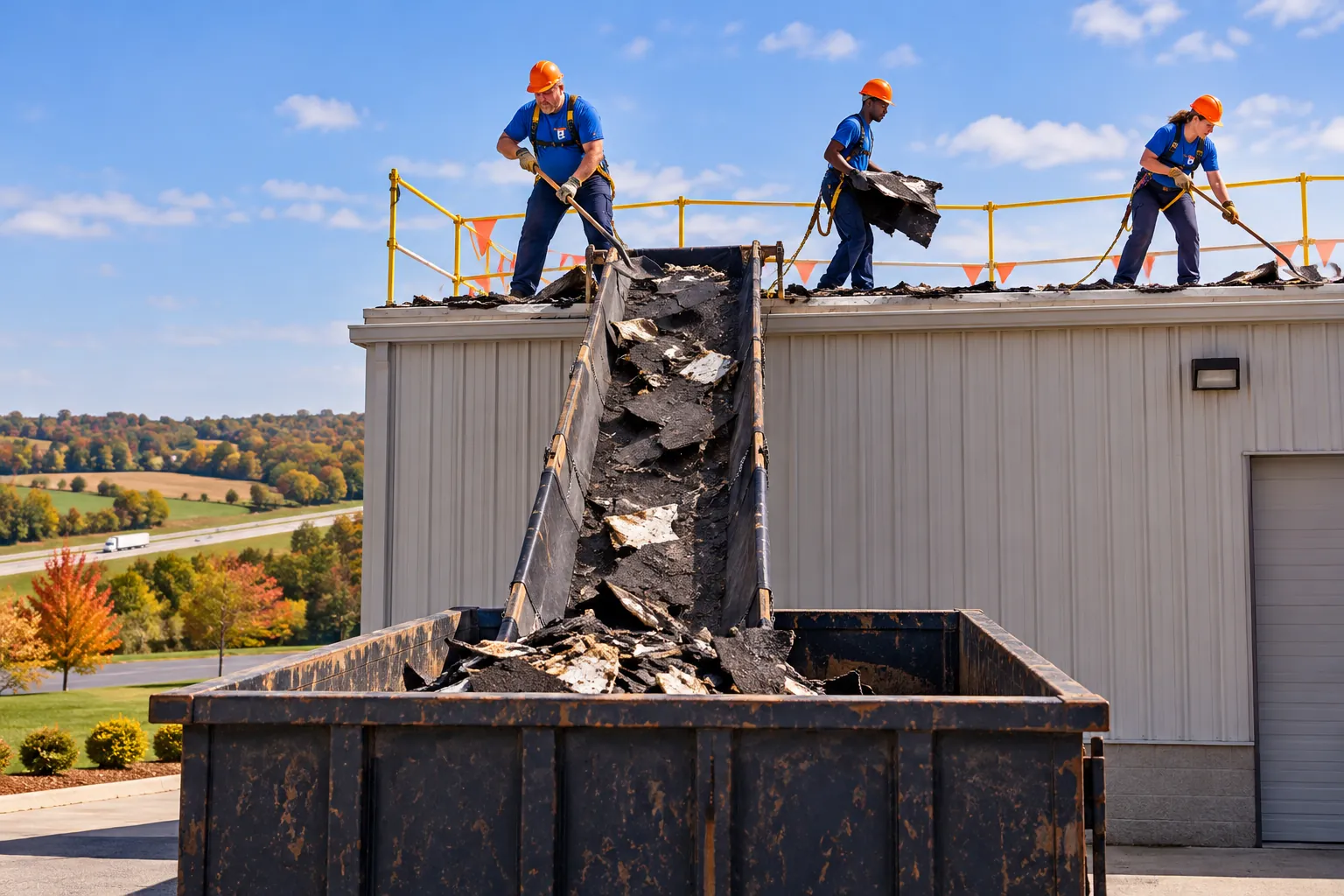
As a Bowling Green flat roofing contractor, we handle everything from a recover to a full rebuild from the deck. These rows show which job each condition points to.
| If Your Roof Shows | Recover | Tear-Off To Deck | Add Tapered Slope |
|---|---|---|---|
| One dry built-up layer with gravel and a firm deck | Usually Fits | Sometimes | Sometimes |
| Two existing roof layers already in place | Rarely | Usually Fits | Sometimes |
| Water that sits for days in the same low spots | Sometimes | Sometimes | Usually Fits |
| Rusted steel deck or soft wood deck found in cores | Rarely | Usually Fits | Rarely |
| Parapets with through-wall scuppers that overflow | Sometimes | Sometimes | Usually Fits |
Layer limits come from the Kentucky Building Code, and the building official confirms whether a recover is allowed.
Most flat roof failures come back to water that has nowhere to go. These signs show where it is stuck.
Water sheeting over a parapet or out of a scupper's sides means the scupper is undersized, clogged, or set too high.
Tapered insulation added in an earlier reroof can send more water to an edge gutter than it was sized for.
Gaps in parapet coping let water into the wall and behind the base flashing below.
Drips that show up only after downpours point to ponds rising over flashing or seams.
Tiles that sag or crack under a flat roof often sit below wet insulation holding water against the deck.
Orange flaking on the underside of a steel deck means water has been sitting on it from above.
Ponding left near curbs freezes overnight and works at flashing seams, and wide fields between drains are where it forms.
Raised blisters and cracked, checkered surfacing on built-up or modified bitumen roofs mark a surface near the end of its life.
Missing strainers or bowls cracked at the clamping ring let water bypass the drain and enter the roof.
Each option starts from the deck condition and the drainage plan, then the membrane.
A new membrane over cover board on a dry, single-layer roof, with edges and curbs raised for the added thickness.
Old layers come off, the deck gets inspected in full, and wet insulation and rusted deck are replaced before new work goes on.
Tapered boards, crickets, and saddles build slope toward each drain and steer water around curbs so it stops parking there.
New drain inserts, clamping rings, scupper sleeves, and overflow scuppers through the parapet for times a primary drain clogs.
TPO, EPDM, or PVC goes on top, chosen for cooling load, exhaust on the roof, and cold-weather work.
Fascia, gravel stop, and coping get replaced to the new roof height and fastened at their listed spacing.
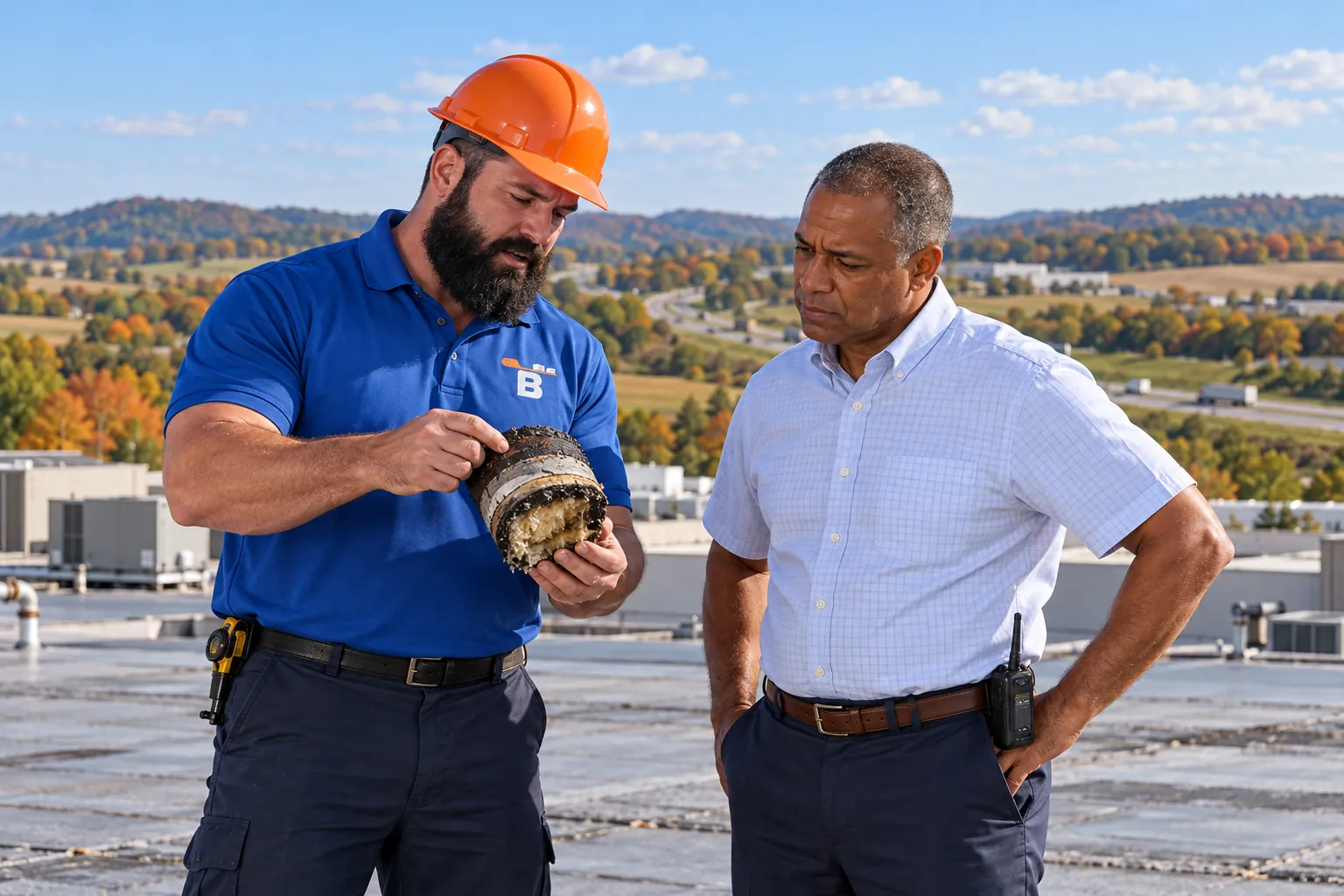
A flat roof rebuilt from the deck up fixes the drainage behind most leaks. These are the gains when slope and insulation are right.
Tapered insulation and crickets move water to drains and scuppers, so ponds stop freezing against seams and curbs.
Wet boards come out during tear-off, which restores insulating value and stops moisture from rusting the deck.
Tear-off exposes the whole deck, so rusted or soft sections get repaired before anything covers them again.
Replacement insulation meets Kentucky's 2012 IECC roof minimums, and edges and curbs are raised to suit the thicker roof.
Overflow scuppers or drains carry water off the roof if a primary drain clogs with leaves or grit.
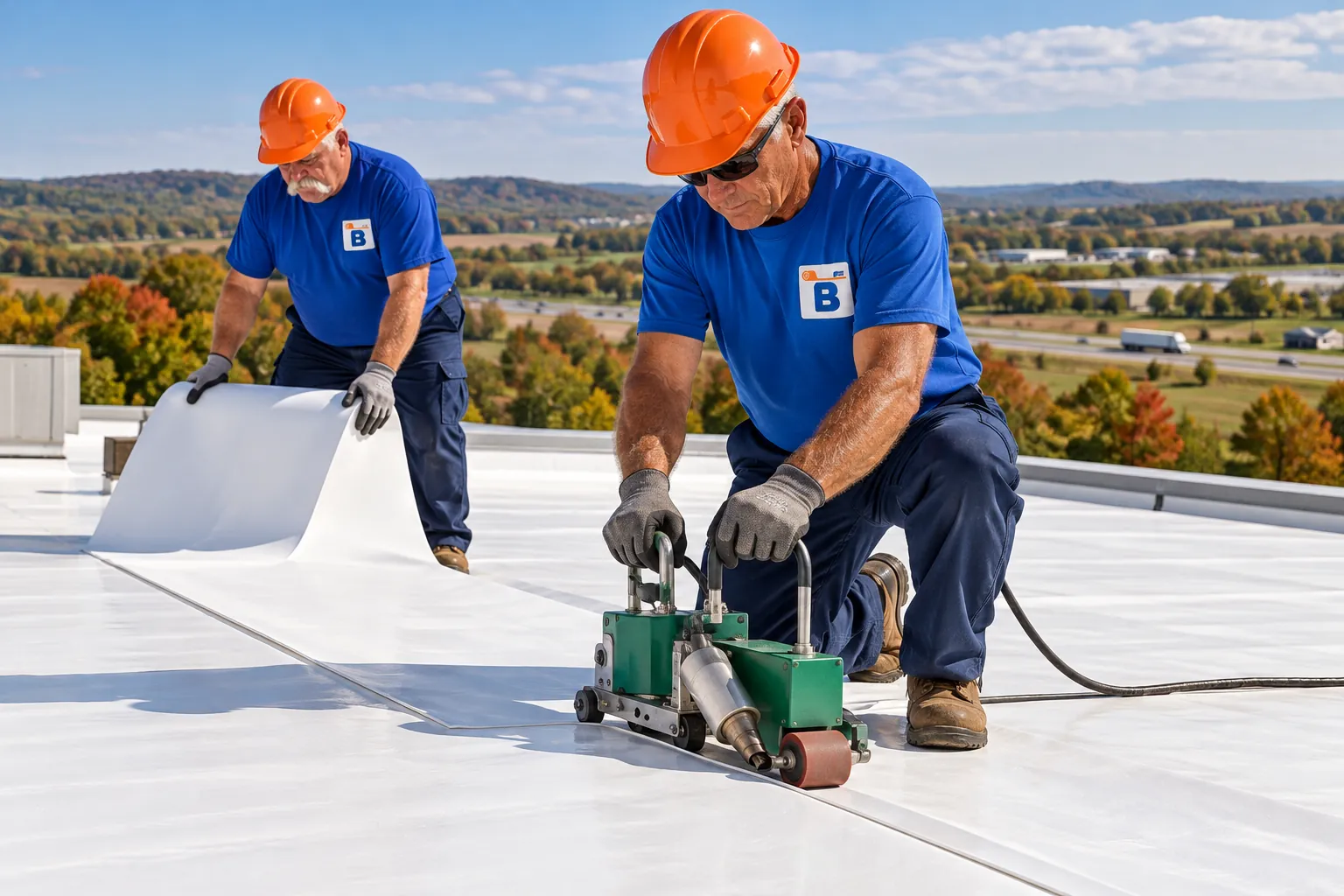
Get a free estimate and tell us where water sits after rain. A tapered insulation layout fixes the slope behind those ponds.
Flat roof replacement runs in sections, so the building stays closed up at the end of each workday.
We walk the field and edges, cut cores to count layers, scan for wet insulation, and note every drain, scupper, curb, and parapet.
Drain locations and low spots set the tapered insulation layout, with crickets around curbs and overflow paths through the parapet.
Crews remove old layers down to the deck in a section sized to be closed up before the end of the workday.
Deck repairs come first, then insulation, tapered boards, cover board, and the membrane, with a tie-in at the edge of each day's work.
New clamping rings go on the drains, scuppers get sleeves, edge metal and coping go on, and seams get probed before the final walk.
Flat roof rebuilds often lead to one of these choices for the top layer or the structure.
White TPO over new tapered insulation suits warehouses and offices with heavy cooling loads.
TPO roofing in Bowling GreenWide EPDM sheets go over one dry existing layer when the roof qualifies for a recover.
EPDM roofing in Bowling GreenSloped framing and steel panels over the old roof send water to new eave gutters where the structure allows.
Commercial metal roofing in Bowling GreenA full replacement covers tear-off to the deck, deck repair where rust or rot turns up, new insulation and tapered boards, cover board, the membrane, flashing at every curb and wall, and new edge metal, coping, and drains.
A recover skips tear-off but still needs a dry roof, a firm deck, and raised edges and curbs.
In most cases. Tapered boards add slope across the field toward each drain, and crickets and saddles turn water around curbs. A few inches of added slope across a long roof keeps water from sitting against curbs. Ponding caused by a sagging deck or structure needs that repair first.
Yes. A built-up or gravel roof is torn off, or recovered when it is a single dry layer, and a TPO, EPDM, or PVC membrane goes on over new insulation and cover board. Gravel gets vacuumed off first on a recover. Parapet scuppers, edge metal, and drains get reworked to the new roof height.
Enough to carry the heaviest rain without water backing up, sized for the roof area and slope. Large roofs need more drains, plus overflow drains or overflow scuppers that carry water when a primary drain clogs.
With Bowling Green near 50 inches of rain a year, drainage sizing sits at the center of every flat roof design.
Parts of it can. Tear-off and mechanically attached membrane go on in cold weather, while adhesives need dry, mild days, so adhered sections and some flashing wait for a warmer stretch. Every open section gets a tie-in before crews leave, since rain or snow overnight would soak exposed insulation.
Rusted steel deck gets cleaned and treated or replaced in sections, and soft wood deck gets cut out and replaced. Tear-off is the one time the whole deck shows, so damage found then gets fixed before insulation goes back. Replaced sections are noted on the roof plan.
Send us the roof size, how many layers you think it has, and where water sits. We start with cores and a slope plan.
Want Us To Call You About Your Roof?
Leave a name and number. Prefer to talk now? Call (364) 205-6781.