Standing Seam Installation
Concealed clips let panels slide with heat and cold, the right seam works on lower pitches, and PVDF paint holds color longest.

As a Bowling Green commercial metal roofing contractor, we install standing seam and R-panel roofs, build retrofits over flat roofs, and repair fasteners, laps, and flashing.
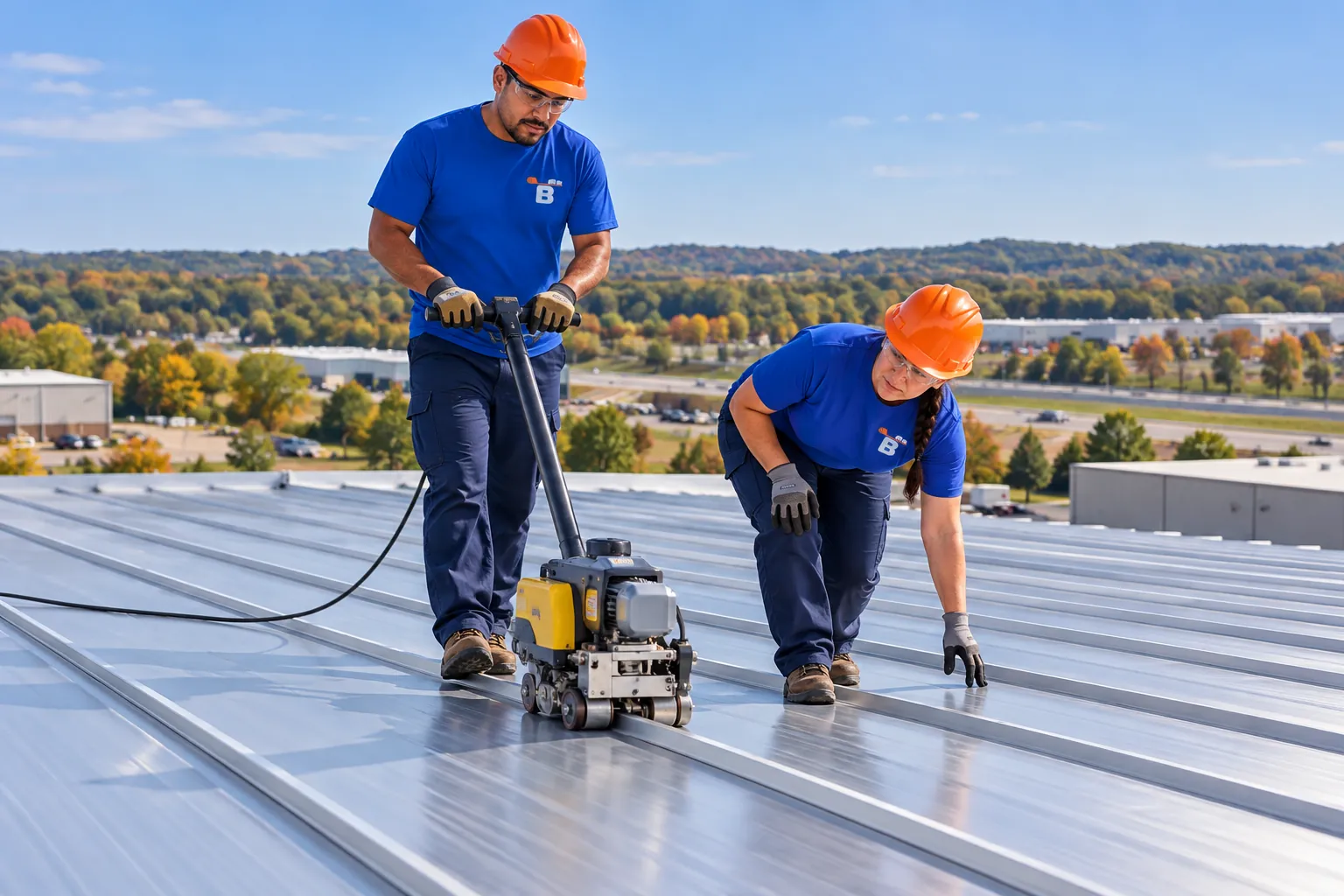
As a Bowling Green commercial metal roofing contractor, we take on everything from new screws to new steel. These rows show which job matches what you see.
| If Your Roof Shows | Repair And Reseal | New Panels | Retrofit Framing |
|---|---|---|---|
| Backed-out screws and cracked washers on solid panels | Usually Fits | Rarely | Rarely |
| Open end laps with rust starting at the overlap | Usually Fits | Sometimes | Rarely |
| Rust-through on many panels or sagging purlins | Rarely | Usually Fits | Rarely |
| A flat roof that ponds under a structure able to carry framing | Rarely | Rarely | Usually Fits |
| Panels torn or bent after high wind | Sometimes | Usually Fits | Rarely |
An engineer checks framing loads before a retrofit, and rusted purlins under a failed panel move the job into structural repair.
Steel roofs fail at the hardware and joints long before the panels wear out. These signs show where to look.
Sliding snow bends gutter brackets late in winter, and long panel runs overfill undersized gutters.
Rake and eave trim lifted by wind lets rain blow under the panel edges and closures.
Orange stains near the eave line mean water is held in the end lap above them.
Leaks in straight rows across a ceiling usually follow fastener rows where washers have cracked.
Water on the underside after cold nights can be condensation from missing or torn vapor retarder facing rather than a leak.
Skylight and curb flashing tied to the panel ribs loses its seal as closures shrink and fasteners loosen.
Panels move with heat and cold, and on exposed-fastener roofs that movement walks screws out of the purlins.
Laps that have opened let water run between panels, where it rusts the steel from inside the overlap.
Ridge caps and foam closures loosened by wind leave gaps at the top of every panel run.
We install new steel, build retrofit roofs over flat ones, and repair the hardware and joints on existing metal.
Concealed clips let panels slide with heat and cold, the right seam works on lower pitches, and PVDF paint holds color longest.
Exposed-fastener panels screwed through the face into purlins, common on shops, barns, storage, and warehouses.
Light-gauge sub-framing creates new pitch over a ponding flat roof, with gutters at new eaves and an engineer's load check first.
Backed-out or rusted screws swapped for the next size with new washers, and open laps resealed with butyl tape and stitch screws.
Rusted-through or dented-through panels removed and replaced in matching profile and gauge.
Ridge caps, eave and rake trim, closures, and gutters reset, plus spring and fall roof walks of fasteners and sealant.
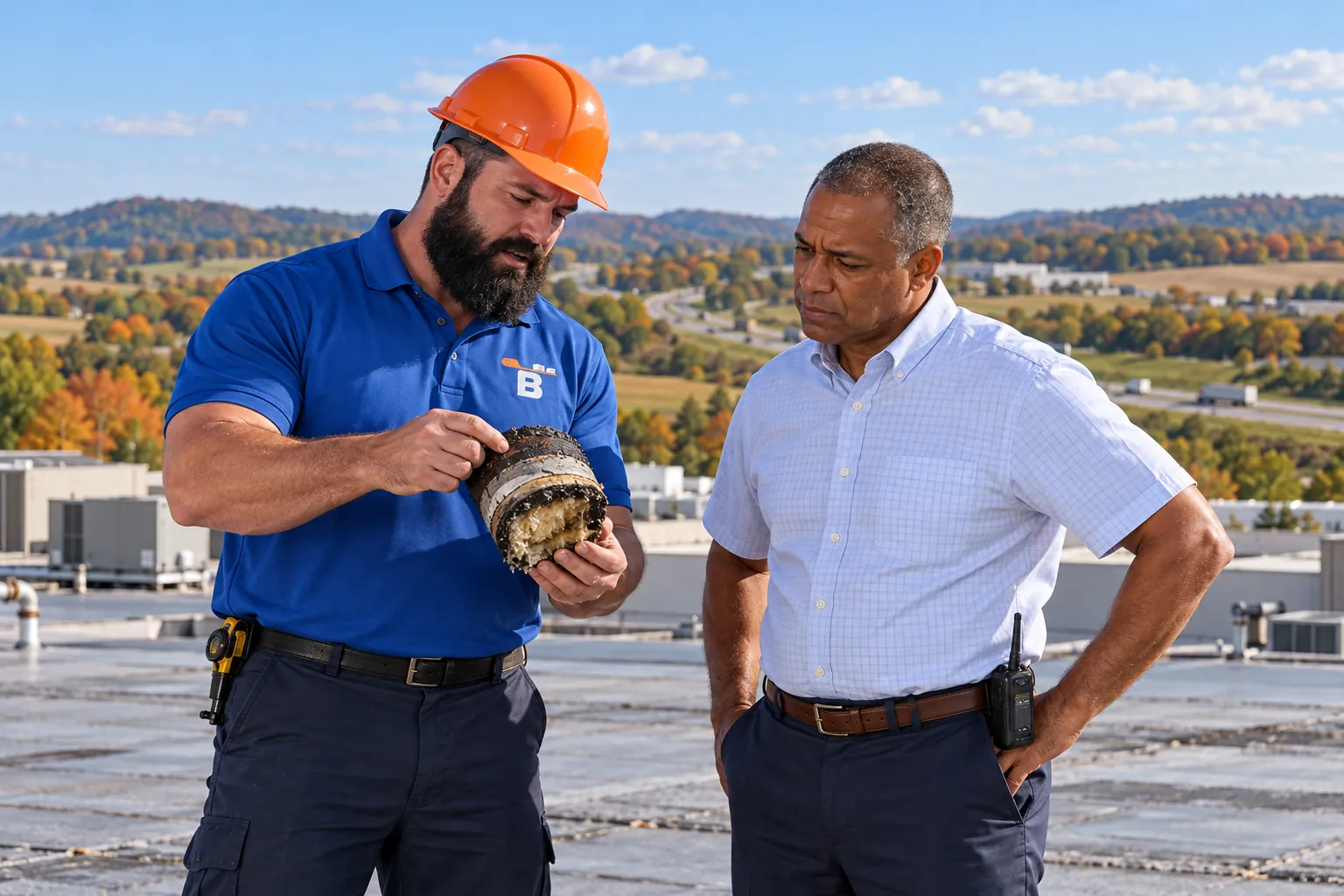
Steel roofs hold up when fastening, laps, and insulation are handled with care. These are the gains.
Corner and edge zones get tighter clip or screw spacing than the field, which matters on buildings beside open fields where wind arrives unbroken.
Faced blankets with taped seams, or rigid board with underlayment, control the condensation that otherwise drips like a leak.
A lower gauge number means heavier steel panels that dent less under foot traffic and hail.
Retrofit framing ends chronic ponding by giving water a pitch to a new eave and gutter.
Spring and fall roof walks find loose screws, cracked sealant, and bent brackets before water reaches the ceiling.
Get a free estimate for refastening, lap sealing, or new panels. Tell us the panel type and where the leaks show inside.
New metal roofs go on from the framing up, with each layer fastened for wind and sealed against condensation.
We walk the roof or the bare frame, check purlin spacing and straightness, and look for rust at laps, trim, and existing fasteners.
Faced blankets over purlins with thermal blocks, or rigid board over a deck, sized to Kentucky's 2012 IECC roof minimums, with facing seams taped.
Panels go down with clips or screws in the maker's listed pattern, tighter at corners and edges than across the field.
Ridge caps, eave and rake trim, and foam closures are stitch-screwed in place, and skylight and curb flashing is tied to the ribs.
Gutters sized for long panel runs go up, downspouts are checked, and the roof is walked with you before the crew leaves.
Metal buildings often share a property, or a roof line, with other systems.
Buildings with metal over the shop and a membrane over the office get both roofs traced and repaired.
Commercial roof repair in Bowling GreenPre-engineered plant buildings get metal work planned around production, lifts, and exhaust.
Industrial roofing in Bowling GreenLow-slope sections next to metal get rebuilt with slope and new transition flashing where the two roofs meet.
Flat roofing in Bowling GreenStanding seam hides its fasteners under raised seams and rides on floating clips that let panels slide with temperature, while R-panel is screwed through the face into the purlins.
Standing seam works on lower pitches with the right seam, often in 24 gauge with PVDF paint. R-panel needs more pitch at the laps, often in 26 gauge with SMP paint, and is common on shops and barns.
Sloped framing goes over the existing flat roof and gets covered with standing seam or R-panel steel. Light-gauge sub-framing attaches to the structure to create the new pitch, and the old membrane often stays in place.
Gable ends, parapets, unit curbs, and drains get reworked because water now runs to new eave gutters. An engineer checks the framing loads first.
Framing checks, insulation, vapor control, panels, trim, and gutters, in that order. Purlins are checked for spacing and straightness, insulation is sized to Kentucky's 2012 IECC minimums, and facing seams are taped. Panels are fastened in the listed pattern with tighter spacing at corners and edges, then ridge caps, trim, closures, and gutters go on.
Repairs target the hardware and joints, and intact panels stay. Backed-out or rusted screws get the next size up with new washers, open laps are cleaned, resealed with butyl tape, and stitch-screwed, and rusted-through panels are replaced in matching profile and gauge.
On older Warren County farm and shop buildings, rusted purlins sometimes turn up, which moves the job into structural repair.
Spring and fall roof walks, plus one after any severe weather warning from NWS Louisville.
Each visit clears gutters, valleys, and downspouts, lifts debris off panels, checks fastener rows, looks at sealant at boots, vents, and curbs, and checks trim and ridge caps for wind damage. Late winter is the time to check gutter brackets bent by sliding snow.
Faced blanket insulation runs over the purlins with thermal blocks, or rigid board goes over a solid deck. The vapor retarder facing gets taped at every seam, because warm indoor air reaching cold steel condenses and drips like a leak. On a solid deck, underlayment takes the place of the facing.
Tell us the panel type, the building, and where water shows. We check fasteners, laps, and purlins, then lay out repair or new steel.
Want Us To Call You About Your Roof?
Leave a name and number. Prefer to talk now? Call (364) 205-6781.