Membrane Seam Repair
Open TPO or PVC laps get cleaned and rewelded or covered with a welded strip, and EPDM laps get primer, seam tape, and lap sealant.

As a Bowling Green commercial roof repair contractor, we trace leaks to the seam, curb, or drain, repair them in matching material, and say when patching has run its course.
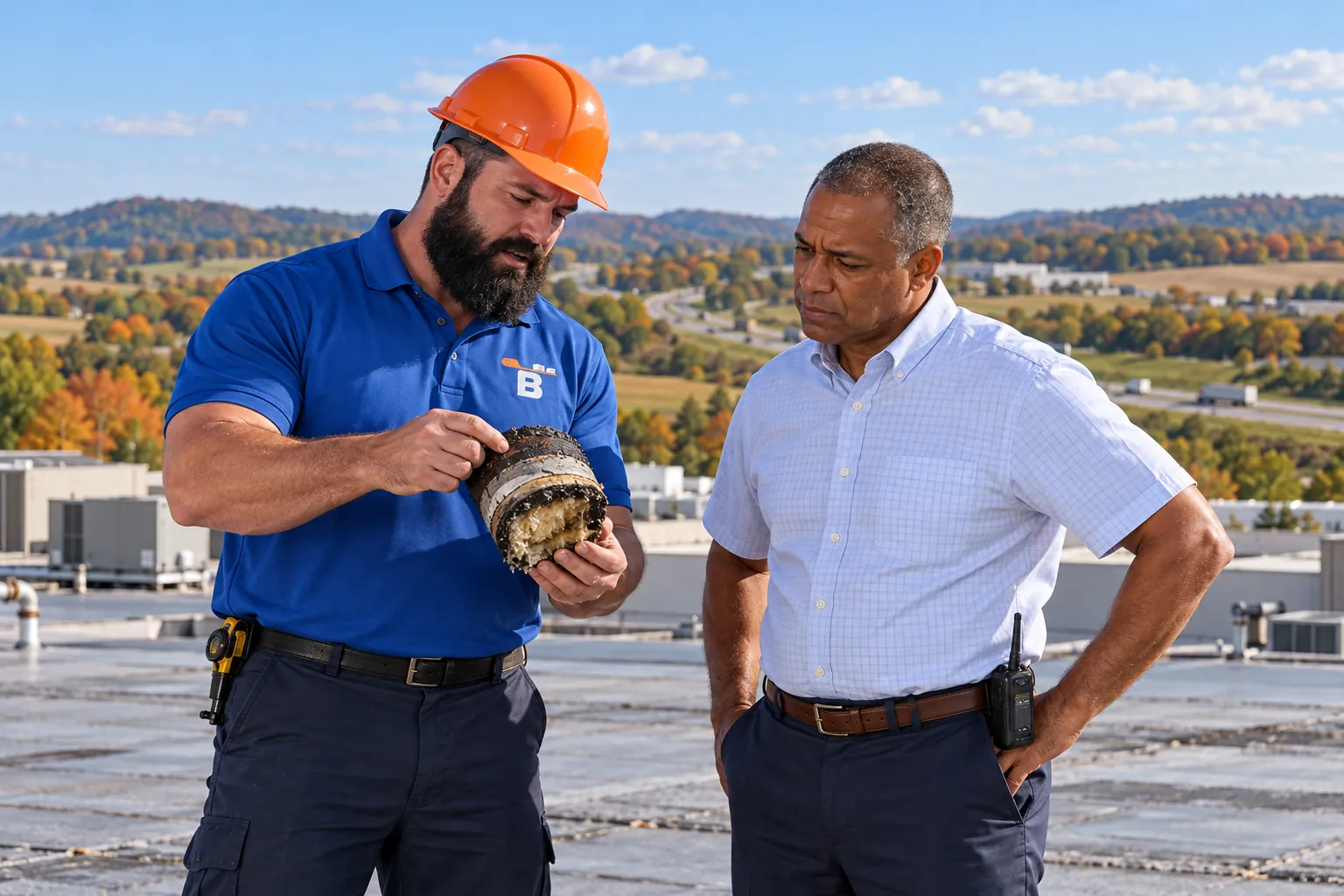
As a Bowling Green commercial roof repair contractor, we repair when the problem is local and the insulation under it is dry. These rows show where repair holds and where it grows.
| If Your Roof Shows | Spot Repair | Section Rebuild | Replacement Talk |
|---|---|---|---|
| One open seam or a split pipe boot on a dry roof | Usually Fits | Rarely | Rarely |
| Curb or parapet flashing pulled loose after a storm | Usually Fits | Sometimes | Rarely |
| A few backed-out screws or an open end lap on metal panels | Usually Fits | Rarely | Rarely |
| Wet insulation in one bay around a drain | Sometimes | Usually Fits | Rarely |
| Seams opening in many places and blisters across the field | Rarely | Sometimes | Usually Fits |
Core cuts beside the leak tell us which column a roof sits in before any repair is priced.
Leaks rarely show up where they start. These are the signs owners report, sorted by where you notice them.
A wavy or lifted edge strip means cleats or fasteners have let go, leaving the membrane edge open to wind.
Dark streaks under a through-wall scupper point to a failed sleeve or a gap where it meets the membrane.
Metal panels sitting uneven at the eave often have stripped or backed-out screws higher up the run.
Water that shows only in wind-driven rain usually enters at counterflashing, coping joints, or a wall above the roof line.
A stain near a rooftop unit tends to trace back to curb flashing, the unit's own panels, or a condensate line.
Drips at a skylight curb come from cracked sealant, a curb flashed too low, or a cracked dome.
Lap edges that lift on TPO, EPDM, or modified bitumen are the most common source of a field leak.
Leaves and grit around a drain bowl hold water against the clamping ring and the flashing beside it.
Raised screw heads and cracked washers on exposed-fastener panels let water run straight down the shank.
Each repair matches the roof system already in place, so patches bond and flash the way the original did.
Open TPO or PVC laps get cleaned and rewelded or covered with a welded strip, and EPDM laps get primer, seam tape, and lap sealant.
Flashing at units, pipes, and vents gets rebuilt to full height, with pitch pans swapped for sealed curbs or boots where the opening allows.
Loose fascia, gravel stop, and parapet coping get new cleats, fasteners at the listed spacing, and sealed joints that hold the membrane edge in wind.
Clamping rings, strainers, cracked drain bowls, and scupper sleeves get reset or replaced, and low spots near drains get tapered insulation.
Backed-out screws get the next size up with new washers, open laps get butyl tape and stitch screws, and rusted-out panels get matching steel.
Wet boards found by core cuts get cut out and replaced at matching thickness, and the deck gets checked before the membrane closes over it.
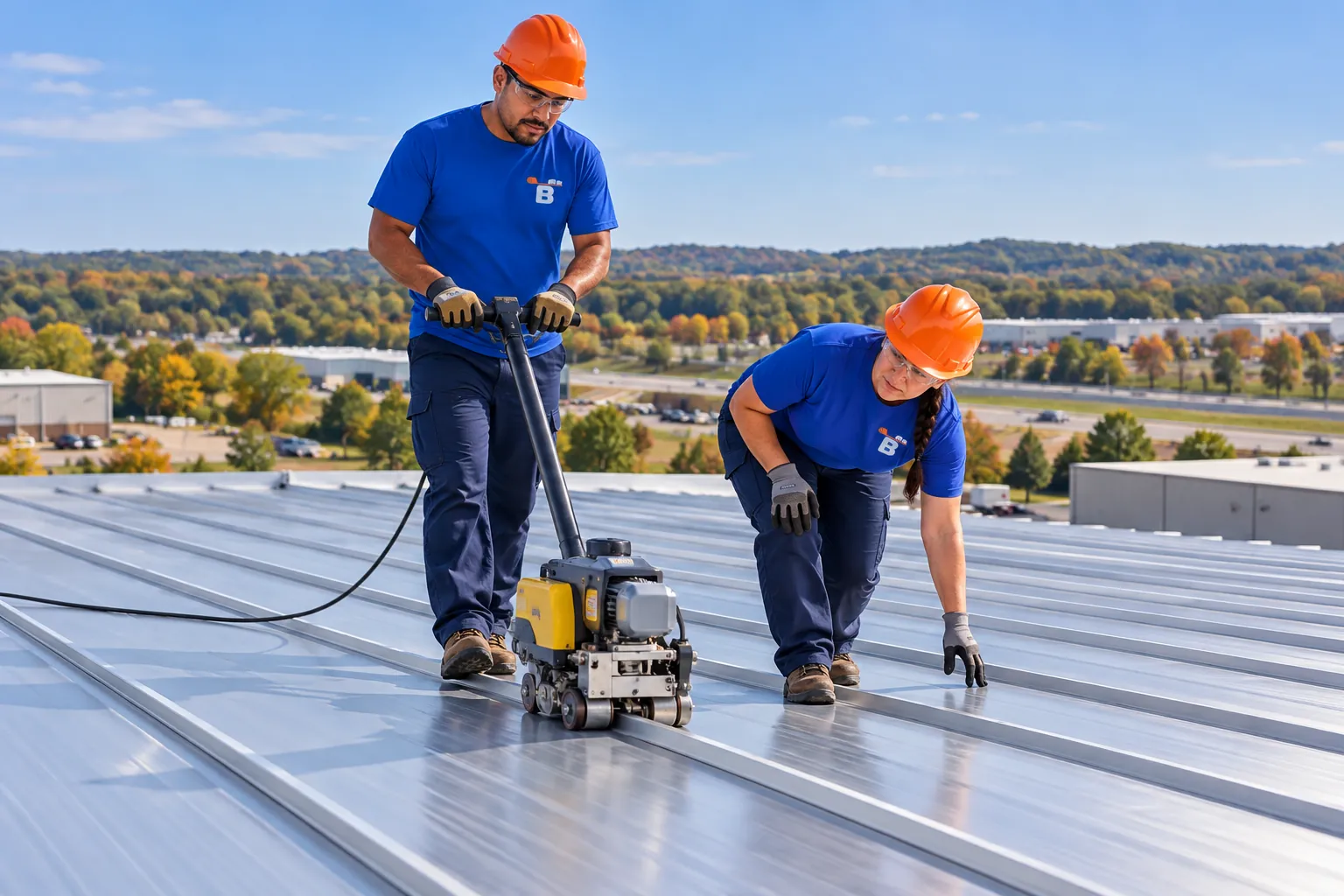
A repair pays off when it fixes the entry point that let water in. Done that way, these are the gains.
Tracing water to the seam, boot, or coping joint keeps the same leak from turning up a few feet away next season.
Closing a leak early keeps water from spreading through insulation boards, which turns a small repair into a section rebuild.
Patches in the same membrane or panel profile bond and move with the roof around them, so the repair ages with the roof.
Core cuts show when a roof is past repair, so money goes to replacement planning instead of a string of patches.
Each repair goes on a marked roof plan with its date and location, which speeds up the next leak call.
Call us with the building address, where water shows inside, and what sits on the roof above that spot. A temporary repair can hold until the permanent fix.
Repairs follow the water from the inside stain back to the roof, then get tested before we leave.
We start inside at the stain, then walk the roof above it, checking seams, curbs, drains, and edge metal along the path water could travel.
Seam probes find open laps, and small core cuts near the leak show whether the insulation is wet and how far the water has spread.
Welded strips go on TPO, taped patches on EPDM, and sealed laps and new screws on metal, each flashed to the height the detail needs.
Where the leak allows it, a hose test on the repaired seam, curb, or drain confirms water stays out before the area is closed up.
Each repair goes on a roof plan with its date, and anything pointing toward replacement is listed so you can budget for it.
Some repairs show a roof that needs more. These services pick up where patching stops.
When seams fail across the field, a new white TPO membrane replaces the patchwork on warehouse and retail roofs.
TPO roofing in Bowling GreenWet insulation over large areas moves the job to a rebuild, with tapered insulation that fixes the ponding behind the leaks.
Flat roofing in Bowling GreenSteel roofs with rust-through or loose screws across many runs get a full refastening plan or new panels.
Commercial metal roofing in Bowling GreenStarting inside, we mark the stain and note what sits above it on the roof: a curb, pipe, skylight, drain, or wall.
Then we walk the roof uphill of that spot, probe seams, and check flashing heights. Water often travels along the deck before it drips, so the entry point can sit several feet from the stain.
We do. On TPO and PVC, open laps get cleaned and rewelded with hot air or covered with a welded strip.
On EPDM, the lap is cleaned, primed, and closed with seam tape, with lap sealant at the edges. Modified bitumen seams get heat-welded or set in compatible cement, depending on how the roof was installed.
A temporary repair stops water long enough to protect the building, such as a patch or tie-in placed during rain or cold weather.
A permanent repair matches the roof system, is cleaned and then adhered or welded, and is flashed to full height. We tell you which one went on and when the permanent repair is scheduled.
Yes. Curb flashing gets run up the curb sides to full height and ended under the unit's counterflashing. Pipes get boots sized to the pipe, and old pitch pans get swapped for sealed curbs or boots where the penetration allows.
If a unit sits on a curb too low for proper flashing, raising the curb goes into the scope.
Three signs: leaks keep showing up in new spots, core cuts find wet insulation across large areas, and seams or membrane fail across the field rather than at one detail. At that point a recover or tear-off usually costs less than the patches it replaces, and the core cut results back up that call.
Both. Metal repairs swap backed-out or rusted screws for the next size with new washers, reseal open end laps and side laps with butyl tape and stitch screws, and replace rusted-through panels with matching profile and gauge. If rusted purlins turn up under a failed panel, structural repair comes first.
Tell us where the water shows and what roof system you have. We trace it, fix it in matching material, and mark it on your roof plan.
Want Us To Call You About Your Roof?
Leave a name and number. Prefer to talk now? Call (364) 205-6781.