Fully Adhered EPDM
Bonding adhesive holds the sheet over insulation or cover board, leaving the field free of fastener rows and ballast.

As a Bowling Green EPDM roofing contractor, we install and recover rubber membrane roofs on schools, offices, and older flat-roofed buildings, with taped seams and full-height flashing.
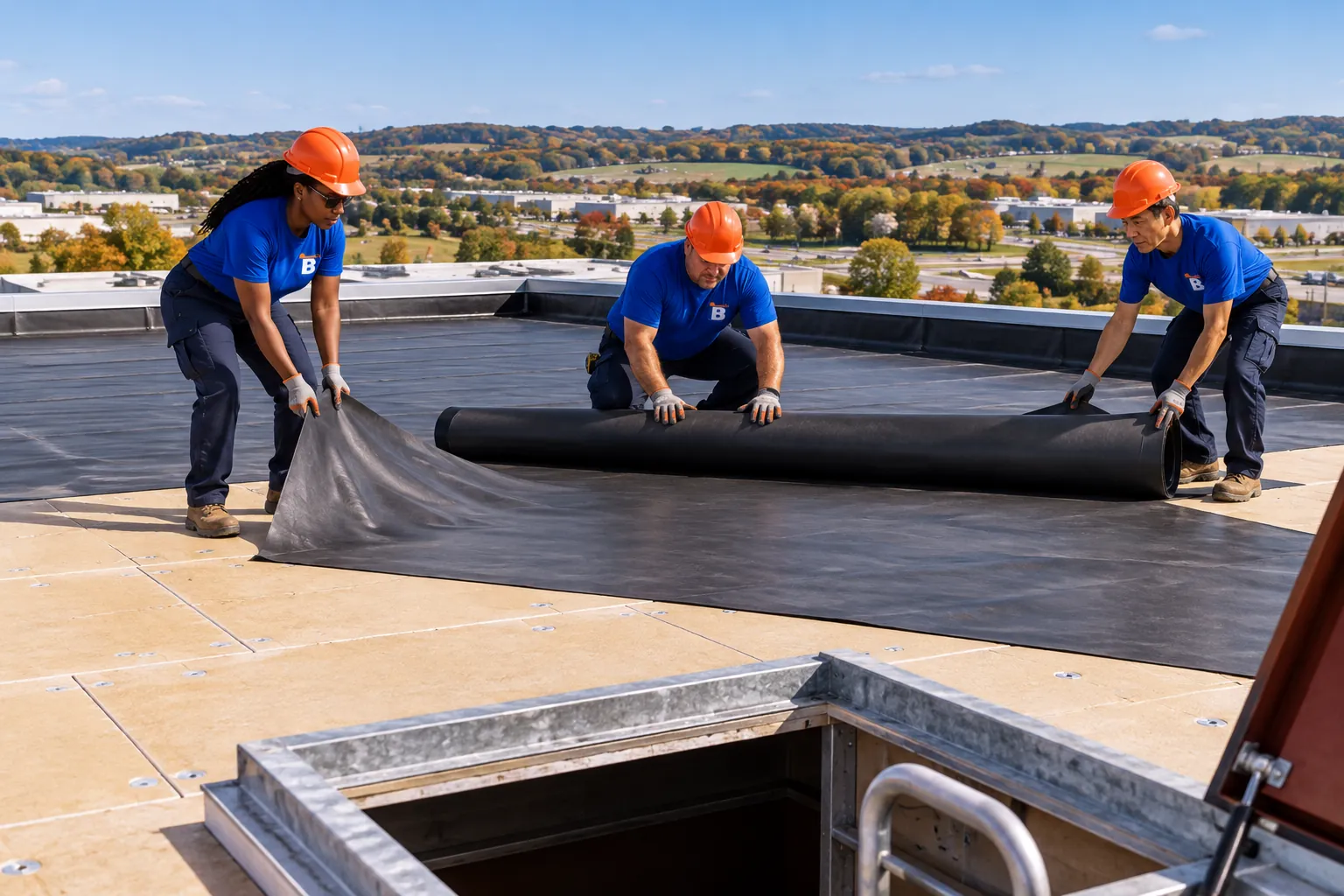
As a Bowling Green EPDM roofing contractor, we put EPDM on wide flat roofs and recovers over dry roofs. These rows show where it fits and where another sheet works better.
| If Your Roof Shows | New EPDM | EPDM Recover | Choose Another Sheet |
|---|---|---|---|
| A wide, plain flat roof with few penetrations | Usually Fits | Sometimes | Rarely |
| An older built-up roof that is dry over a firm deck | Sometimes | Usually Fits | Rarely |
| A heated shop with little cooling load | Usually Fits | Sometimes | Rarely |
| Kitchen or process exhaust putting grease on the roof | Rarely | Rarely | Usually Fits |
| Wet insulation trapped under the old roof | Usually Fits | Rarely | Rarely |
Grease and oils swell and soften EPDM, so roofs under exhaust fans get a PVC or KEE sheet instead.
Rubber roofs age in a few familiar ways. These signs point to the seam, flashing, or edge we check first.
Loose cover tape over the joint at fascia or gravel stop lets water under the membrane at the roof edge.
Wall flashing that has slid down a parapet shows as a sag line below the coping or termination bar.
Runoff stains below an edge or scupper point to a gap between the membrane and the metal it laps onto.
Water inside along an exterior wall often enters where flashing sits too low and standing water tops it.
A ceiling stain that grows with each rain means water is moving through wet insulation from a single entry point.
Inside and outside corners at curbs are where EPDM flashing sheets crack or pull away first.
Seam tape that has let go at a lap edge, often at T-joints with no lap sealant, is the classic EPDM leak.
Wrinkles beside drains and ponds near curbs come from a sheet that shrank or insulation that crushed.
Blisters under an adhered sheet mark spots where adhesive let go or moisture is trapped below.
EPDM goes on in a few ways, chosen by what is under it now and how the building uses the roof.
Bonding adhesive holds the sheet over insulation or cover board, leaving the field free of fastener rows and ballast.
Plates and fasteners in the laps hold wide sheets on steel decks, which keeps adhesive work to the details.
A new sheet goes over one dry existing roof after gravel is vacuumed off, blisters are cut flat, and cover board is set.
Black absorbs heat and suits heated shops, while a white top layer over a black core cuts summer heat on cooled buildings.
Parapets, curbs, and roof edges get new EPDM flashing, termination bars, and cover tape, set high enough to clear standing water.
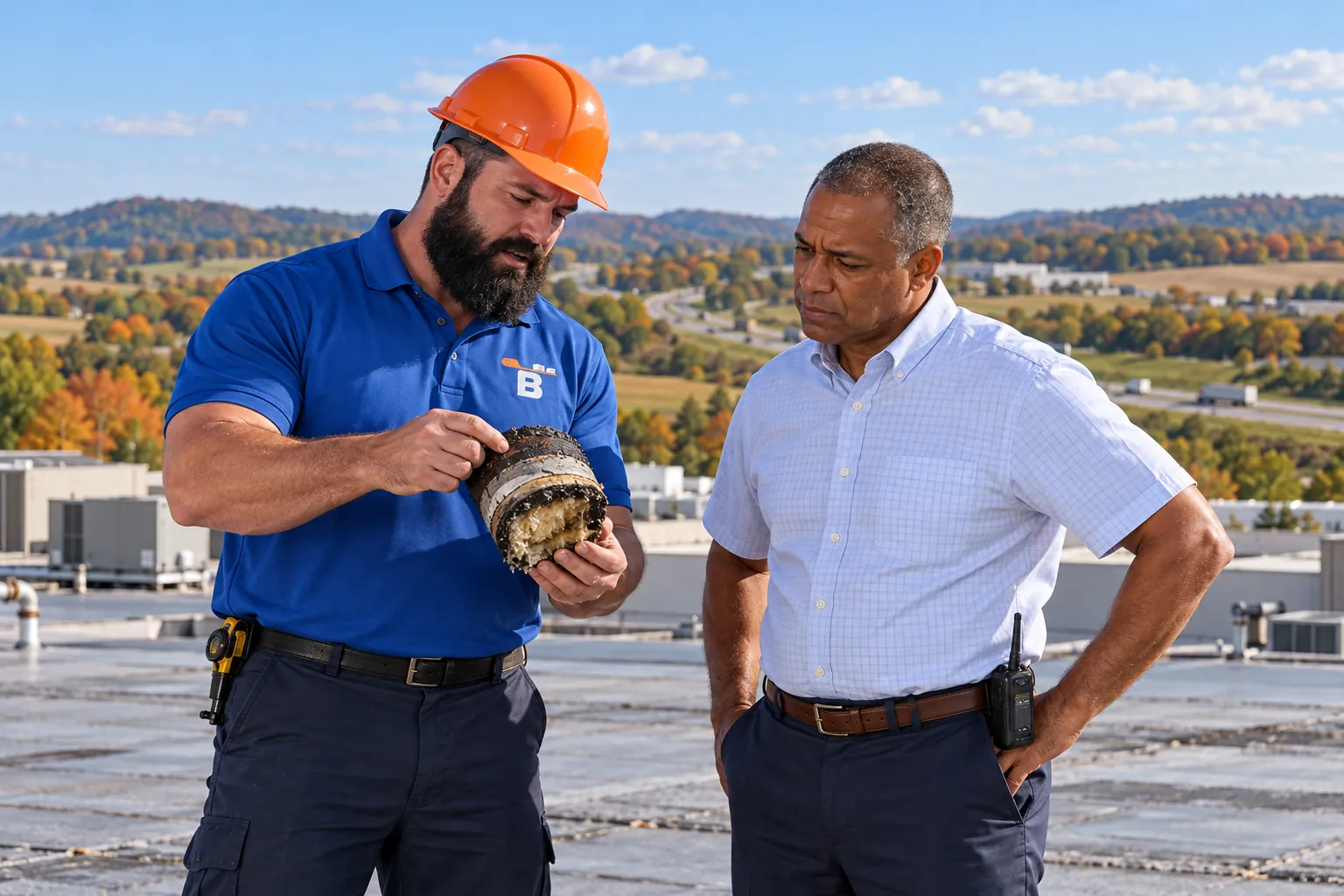
EPDM's gains come from wide sheets and a forgiving material. They hold up when seams and flashing are done with care.
EPDM comes in large sheets, so a wide flat roof carries fewer laps, and fewer laps mean fewer places for water to enter.
The rubber stays pliable in the cold, which helps when roof work has to happen during a Kentucky winter.
A dry roof over a firm deck can take a new EPDM sheet over the old one, once the building official confirms the layer limit.
Uncured EPDM flashing stretches around inside corners, curbs, and pipes, so odd penetrations get a shaped seal.
Black for heated shops with little cooling, white for buildings with big rooftop units and long summer hours.
Call us with the roof's age and where the laps are opening. Seam repair or a recover gets settled on the first roof walk.
EPDM work is mostly preparation: clean laps, a flat substrate, and flashing at the right height.
We walk the roof, run a moisture survey, cut cores to count layers, and check flashing heights at every wall and curb.
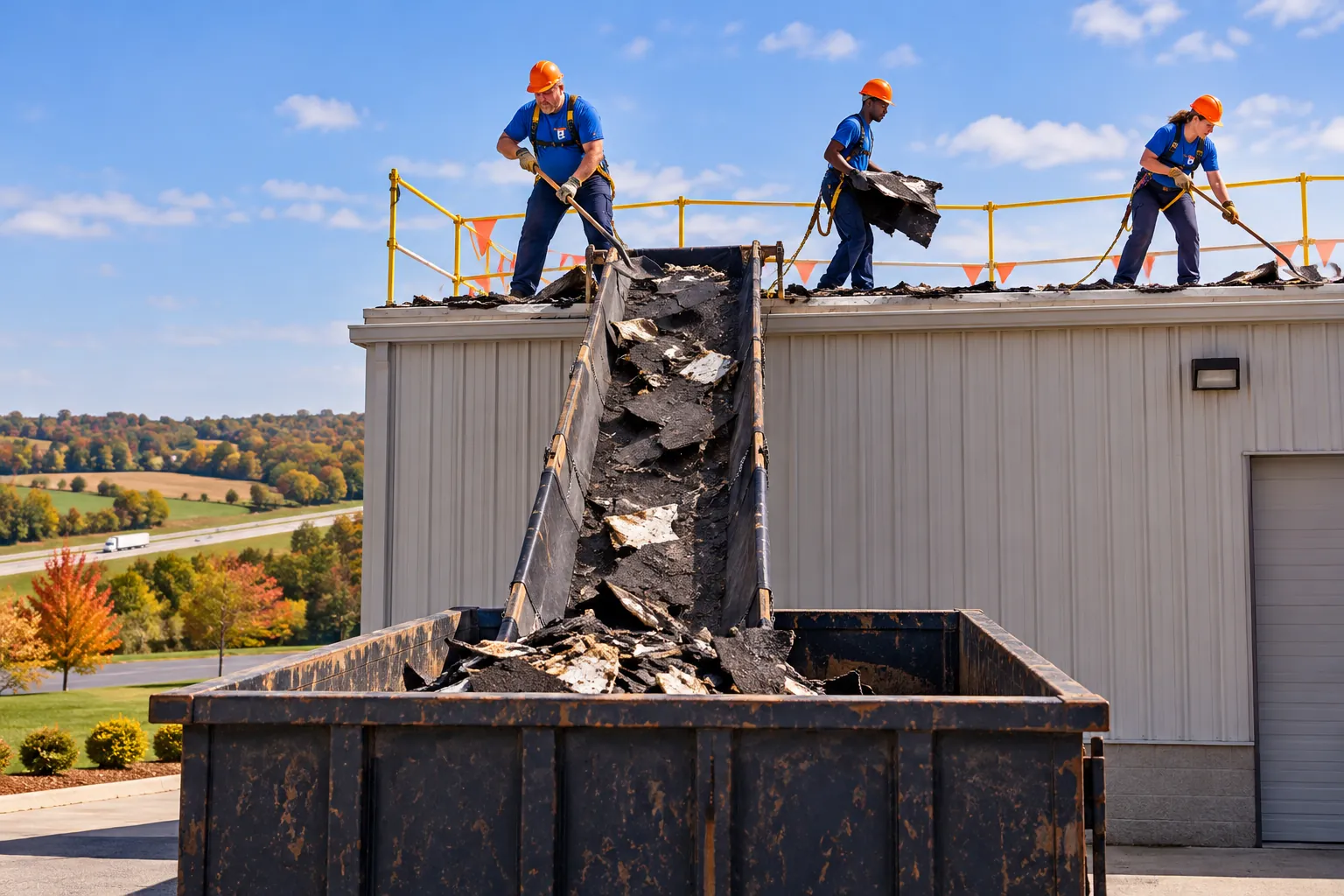
Wet insulation comes out, gravel is vacuumed off a built-up roof, blisters are cut flat, and cover board or insulation goes down.
Sheets are relaxed, positioned to limit laps, and adhered or fastened, with seam lines marked before any taping starts.
Each lap is scrubbed of dust and talc, primed, taped, and rolled in two directions, with lap sealant at T-joints and corners.
Uncured flashing wraps corners and pipes, drains get clamped, and edges get metal with cover tape over every joint.
EPDM is one answer for a flat roof. These services cover the others.
A white welded TPO sheet suits warehouses and offices with heavy rooftop units and long cooling seasons.
TPO roofing in Bowling GreenWhen drains and slope need work too, a rebuild adds tapered insulation and new edge metal.
Flat roofing in Bowling GreenCurling laps and cracked corner flashing on an existing rubber roof get primer, tape, and uncured flashing.
Commercial roof repair in Bowling GreenEPDM is synthetic rubber with seams joined by tape and primer, while TPO and PVC are thermoplastics welded with hot air. EPDM comes in black or white, stays pliable in cold weather, and comes in large sheets with fewer seams.
Its weak point is grease and oil. PVC resists fats and oils best, which is why it shows up near restaurant and plant exhaust.
Crews mark the lap line, scrub dust and talc off both sheets, apply primer, lay the seam tape, and roll it in two directions. Primer and roller pressure set the bond, so the prep on each lap decides how well it holds. Lap edges at T-joints and corners get a bead of lap sealant.
It depends on the building. A heated shop with little cooling and good insulation gains little from white.
A warehouse or office with large rooftop units and long summer hours gains more from a white sheet, which has a white layer over a black core. Both colors use the same seams and details, and white shows dirt near exhaust fans sooner.
Yes, when the old roof is dry, the deck is firm, and the code allows another layer. A moisture survey comes first, since wet insulation trapped under new EPDM keeps rusting or rotting the deck.
Gravel gets vacuumed off, blisters are cut flat, a cover board goes down, and edges, curbs, and drains are raised to the new height.
Flashing goes wherever the membrane meets a wall, curb, pipe, drain, or edge. Parapets get EPDM run up the wall and finished under coping or a termination bar.
Curbs get flashing sheets with sealed corners, pipes get pre-molded boots, drains get the sheet clamped under the ring, and edges get metal with cover tape. Flashing has to stay higher than standing water.
Often. Curling laps get cleaned, primed, and retaped, cracked corner flashing gets replaced with uncured EPDM, and punctures get a primed patch. Core cuts near the leaks decide it, since a dry roof with local failures repairs well, while wet insulation across the field points to a recover or tear-off.
Tell us the roof size and what covers it now. We start with a moisture survey, then lay out repair, recover, or a new sheet.
Want Us To Call You About Your Roof?
Leave a name and number. Prefer to talk now? Call (364) 205-6781.